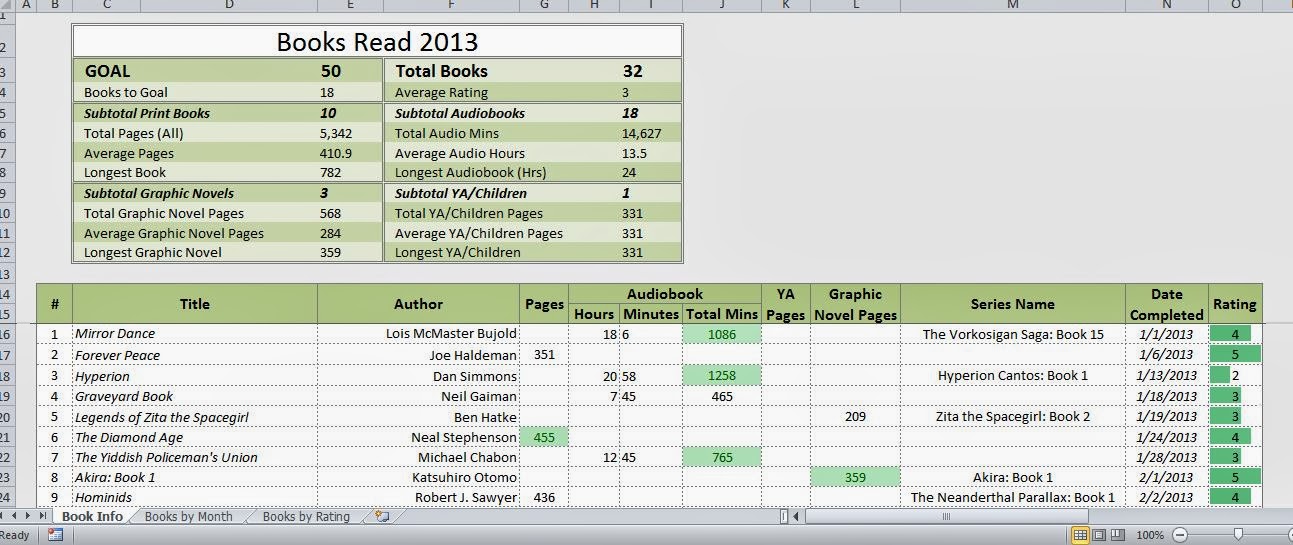
I recently mentioned that I have backed off my original goal for finishing the Hugos. I also thought I might have a better idea of how far off I am.
It took me nine weeks to read Jonathan Strange & Mr. Norell. It was an extraordinarily long book, but it wasn't nine weeks long. While I was reading it, I was also studying for the GRE and I may have watched an episode or two, or a season, of Downton Abbey when I wasn't jamming books in my face.
Now I have found myself back in school, still working, still a dad, and with just over a handful of Hugo's left, some of them being nearly as ridiculously long as Jonathan Strange. That is to say, I've taken too long to finish the Hugo's and now I'll have more reading with more urgent deadlines and all of my usual things to do and a lot less time to fit the Hugo's in.
I had originally envisioned that I would go back to this year, but I had also thought I would be done with the Hugos by then. Ha!
So, how do I now approach these final Hugos?
Well, to start, I should explain that I am a slow reader, or I should say that I am a careful reader. I read and re-read passages that are confusing, enlightening, awkward, or just rad. I stop and think. I drink a little wine. I figure reading a novel should be taken seriously and approached with the same gravitas that any thousands of years old craft deserves (kind of makes you wonder why I started this challenge right?) Okay, sometimes I read while Emmeline watches Powerpuff Girls or My Little Pony, but when I can, I like to have all my things arranged and I like to dig in. This challenge aside, I take forever to read even the shortest books and I like it that way.
When I started this challenge, I finished each book with days to spare. I was psyched, the books were shorter, I was staying up until all hours of the night and operating during the day on a tiny, coffee fueled replacement brain. Since then the books have grown longer, I've taken on more commitments, staying up past midnight has become a death sentence, my brain is real (and still tiny) and I've had trouble getting through any book in under two weeks. Erg.
With that in mind, my first thought was to just finish them out via audiobook, because it's possible that I could end up reading these until the end of time, but that's out because they aren't all available at my library. Also, apart being a little disappointed about not meeting my self-imposed goal, I'm not terribly depressed about the idea of continuing this for a little longer.
I don't know yet how easy it will be to balance my required reading and my Hugo reading, but with just few to go, I don' t imagine it will take me more than a few more months. I might take a while to finish the longer books and my posts might be a little irregular for the first few weeks, but hopefully I'll get into a groove soon and everything in the entire world will be perfect. Let's plan on that.
And if all else fails, instead of "64 books in 64 weeks", The Hugo Endurance Project will just have to mean that I'm "reading books to death". It might be a confusing goal at first but I assume the autopsy will clear it right up.
The Hugo Endurance Project
Every Hugo Award winner in 64 weeks!
30 April 2013
28 April 2013
Rainbows End
Stats
Rainbows End
by Vernor Vinge
2007 Hugo
Award Winner
Read by Eric
Conger
Got it
from: Own it
14h 46m
After
medical treatments make it possible for Alzheimer patients to completely
recover, Robert Gu finds himself in a pretty intensive rehab program. He isn’t the person he used to be, and he
doesn’t live in the same world either.
He was a famous poet in a world similar to ours. Now he is no one,
learning how to “sming” and how to interface with computers. It is during his rehab at Fairmont High
School, that Robert becomes embroiled in a conspiracy plot to end all
conspiracy plots.
Multiple realities
So there
is one reality where an author has an uncanny ability to tap into the most
salient features of some really complex issues.
In Rainbows End, Vinge reminds
us how well he capitalizes on our most deep-rooted fears and our most lofty scientific achievements. In beginning this book, I had figured Rainbows End for another goldmine of Vinge-y,
SF goodness…but I didn’t labor under that delusion for long.
I was
excited by the opening computer/chemical warfare plot. I was reminded of the cyber-attacks on
nuclear facilities in Iran going back a couple of years and I thought Vinge
might have been preparing to go bigger. I
was strapping myself in for Vinge’s brand of ultra-paranoia. It harkened to the message boards in A Fire Upon the Deep and man…I ate that
stuff up.
In the
first chapter, “Mr. Rabbit visits Barcelona” (Sweet title. I loved it), Vinge
was poised to capitalize on how compelling and/or dangerous the convergence of several
technological advancements could be in a world where anonymous access is taken
to just about every extreme, and I was ready to follow him wherever he wanted
to go.
Taken
separately, individual elements of Vinge’s future were awe inspiring, but the
other reality of Rainbows End is that
as these elements come together and the story starts to drag on and on, the
final product doesn’t seem equal the sum of its parts.
I almost
think this is worse than having just written a story that falls flat altogether. Vinge touches on all the right topics and
sets himself up for a home run, while everyone is batting blindfolded. Instead of just striking out, as authors do
sometimes, in Rainbows End, Vinge lets
go of the bat and injures some unsuspecting kid in the stands hoping to catch a
foul ball. And I think I might have been
that kid, because this one left me confused.
While I
admit to exclaiming audibly at the coolness
of this or that bit of tech or social construction quite frequently, I didn’t
much enjoy the overall story. Tension?
Not so much. Compelling characters?
Nope. Cool world, but there was never
any reason to be in it.
Recommendation
Consistent
with my
last Vinge experience, Rainbows End
incorporates a plethora of themes both scientific and psychological, and
fantastically so, but it also lacks a lot. Comparing the two Hugo winners that
I’m familiar with, Rainbows End feels
like it occupies a specific place and time in a way that A Fire Upon the Deep did not.
I don’t have much interest in re-reading this one, but I am curious how
it will hold up to another ten years or so.
I might be wrong; it could be like good wine.
I actually
started this review several weeks ago and before I chucked everything I had and
started again, I noticed that this audiobook was only fourteen hours. Not terribly long as far as audiobooks go,
but it felt longer than some of the longest I’ve gone through so far. I guess even though the concepts were
interesting, they only had the power to captivate for so long. Perhaps I’ll enjoy the shorter stories that Rainbows End was based on instead.
HEP SCORE
Universe 4/5
Social/Political
Climate 5/5
Dialogue 3/5
Scientific
Wonders 4/5
Characters
3/5
Overall
19/25
18 April 2013
Stardust Read Along Pt. 2
Well, Stardust was an interesting interlude between the two
other Neil Gaiman novels. I’m glad to
have participated and I always enjoy read alongs because the questions either
require that I think differently about the book or force me to articulate some
half-formed thoughts. Carl is especially
good at generating questions that get to the meat of a story, but also some of
the fun too.
Of course, one of the best parts of a read along is visiting
and discussing with other bloggers. For
Stardust, it has been a great, smart group and I can’t wait to hear from
everyone again. Thanks again Carl for
organizing this and I look forward to the book vs. movie discussion to follow.
So how about Carl's questions.
1. In the first part
we saw a naive, wool-headed and self-involved Tristran. What are your thoughts about Tristran and his
personal journey now that the book has ended?
Carl did a good job of bringing me around to Tristran during
the last discussion. Tristran’s journey
was predictable but fun, funny at times.
At first I wasn’t sure he had changed all that much by the end. Now that I’m sitting here thinking about it
more, I like that Tristran’s journey resulted in a realistic personal
growth. We saw his unhealthy infatuation
with Victoria vanish, his niavete lessen, but his sudden choice to travel the
world with Yvaine recalled some of the old impulsive, romantic Tristran. It seemed a very human way to “grow”.
2. The star, who we
now know as Yvaine, also experienced a transformation of her own. So I ask the same question, what are your
thoughts about Yvaine and the journey she took?
I had a hard time getting on board with Yvaine’s
transformation. I thought the
progression from hating Tristran, to feeling obligated to him, to falling in
love with him was forced and frankly, I failed to make that last jump from
obligation to love. I thought for a
minute I had missed something. Yvaine
seemed to rather abruptly change her mind about him at each stage and I never
really developed much of an emotional connection with her.
I never really saw her as destined for something bigger
either. We meet her as a fallen star
with a broken leg, helpless and I felt rather insipid at times. That she would later become a wise and
balanced ruler was certainly a more appealing fate than just wasting after
Tristan died, but I never got a real sense of a trajectory from her.
I wouldn’t say I was particularly upset about her character
or her journey, but frankly, I didn’t really follow her transformation very
well and as a result didn’t have much of a connection to her.
3. The villains of
the story came to interesting ends, but not necessarily expected ones. How do you feel about Neil Gaiman's handling
of the Stormhold brothers (who had remained at the end of Part 1) and the two
witches, the one Lilim and Ditchwater Sal?
This was certainly the most interesting treatment of
villains I can recall for a long time. I
mentioned how much I enjoyed seeing the witch queen humbled while at the same
time demonstrating her terrible power.
Gaiman only intensified his very unusual handling of villains and I only
enjoyed it, and them, even more in the second half.
4. Were there any
descriptions, characters, settings, plot threads that stood out to you
personally during this second half of the book?
I was rather touched by the carefree approach to
experiencing the world that overtook Tristran and Yvain after leaving
Victoria. There was this one last thing
tethering them to Wall, Tristran’s family and society. Once that was eliminated, and combined with
the feeling from the first half of the book that Tristran’s parents could have
done with a little more upfront honesty about Tristran, their choice to just
aimlessly wander was deeply satisfying to me.
5. At the very end of
the book we see that Tristran and Yvaine's relationship and fate echoes that of
Aragorn and Arwen from The Lord of the Rings.
If this question makes any sense to you (lol), what comparisons and/or
contrasts do you see, especially in the fates of Yvaine and Arwen?
I came to this same conclusion about the two couples
myself. I’m not sure I have a lot to add
about that here though as it was mostly just something of a passing thought
once or twice. What did strike me a
differentiating the two was that Yvaine didn’t seem nearly as concerned about
what her life would be like with Tristran gone.
Perhaps this is the result of a life span counted on a galactic scale,
or because Yvaine was less emotionally tied to her man? I’m not sure I have that answer, I admit it
has been several years since I read LOTR.
6. What are your
overall impressions of the story now that it is done?
In broad strokes, I liked it. Probably my favorite of Gaiman’s stories that
I’ve read. I was fun and whimsical in a
vague and vaguely dark way. I think this
is one to be read several times over the course of a life. I imagine it would take on drastically
different meanings each time.
7. If Gaiman were to
return to Wall/Faerie, would you take another journey there? If so, are there any adventures hinted at in
Stardust that you would like to see Neil expand on?
My first inclination was to say that all I cared about was
Dunstan, but I think I’d also revisit Wall/Faerie for more about any of the
villains. Any of them at all.
14 April 2013
The End of Everything
As we all know, I am the worst at things.
This blog was meant to chronicle my time spent training for my first marathon while at the same time reading through every Hugo Award winning novel in as many weeks as there are winners, or the other way around. Being that there are 64 Hugo winners, including the retros, this meant that had I stayed on schedule the entire time, I would have finished reading every Hugo novel ever, yesterday. Anyone keeping track (to my knowledge this is just me, and that is only sometimes), knows that this has not happened. In fact, I still have yet to finish eight more Hugo's.
Books like Cyteen, Jonathan Strange & Mr. Norell, and the Mars Trilogy, combined with a ton of really poor excuses (which I'm going to lean pretty heavily on anyway) to pretty seriously delay progress at several points over the last few months and even though I'm so near the end, I know that I have a couple of whammies that could still make my life difficult.
At the same time, listening to audiobooks more than I ever thought I would, has also allowed me to make some good time when I otherwise would not have been able to. Currently, I've started, and found many excuses not to dig into, Paladin of Souls and I'm also about two-thirds through American Gods audiobook.
Continuing progress notwithstanding, I have obviously failed meeting my reading goal for this challenge.
The silver lining here is that there are about two maybe three people actually reading anything I write here, and fewer people who care, so I'm thinking no one will really hold it over my head and I can just keep chugging until I get there. Except for myself. You know I'm going to lord it over myself every chance I get.
So, I'm hoping that, if I haven't upset the SF gods too much, I will have an amended goal within the next few days. I should be telling you all how disappointed I am, I am I assure you, but the writing has been on the wall since somewhere around week two, so I've had some time to come to terms with my inadequacies (see first sentence). In terms of the stages of grief, I'm well into Shoving Down Emotions and Proceeding as if Everything is Fine (probably because of all the "handshakefullness" workshops I've been attending).
Light up the comments if you'd like. I deserve it. But know that I'm still going strong, just slower. And to those of you who have been around since the early days AND to those of you who continue to leave comments and encouragement: THANKS AND PLEASE STICK AROUND!
Oh, and if you see my wife around, remind her how patient and forgiving she is :-)
This blog was meant to chronicle my time spent training for my first marathon while at the same time reading through every Hugo Award winning novel in as many weeks as there are winners, or the other way around. Being that there are 64 Hugo winners, including the retros, this meant that had I stayed on schedule the entire time, I would have finished reading every Hugo novel ever, yesterday. Anyone keeping track (to my knowledge this is just me, and that is only sometimes), knows that this has not happened. In fact, I still have yet to finish eight more Hugo's.
Books like Cyteen, Jonathan Strange & Mr. Norell, and the Mars Trilogy, combined with a ton of really poor excuses (which I'm going to lean pretty heavily on anyway) to pretty seriously delay progress at several points over the last few months and even though I'm so near the end, I know that I have a couple of whammies that could still make my life difficult.
At the same time, listening to audiobooks more than I ever thought I would, has also allowed me to make some good time when I otherwise would not have been able to. Currently, I've started, and found many excuses not to dig into, Paladin of Souls and I'm also about two-thirds through American Gods audiobook.
Continuing progress notwithstanding, I have obviously failed meeting my reading goal for this challenge.
The silver lining here is that there are about two maybe three people actually reading anything I write here, and fewer people who care, so I'm thinking no one will really hold it over my head and I can just keep chugging until I get there. Except for myself. You know I'm going to lord it over myself every chance I get.
So, I'm hoping that, if I haven't upset the SF gods too much, I will have an amended goal within the next few days. I should be telling you all how disappointed I am, I am I assure you, but the writing has been on the wall since somewhere around week two, so I've had some time to come to terms with my inadequacies (see first sentence). In terms of the stages of grief, I'm well into Shoving Down Emotions and Proceeding as if Everything is Fine (probably because of all the "handshakefullness" workshops I've been attending).
Light up the comments if you'd like. I deserve it. But know that I'm still going strong, just slower. And to those of you who have been around since the early days AND to those of you who continue to leave comments and encouragement: THANKS AND PLEASE STICK AROUND!
Oh, and if you see my wife around, remind her how patient and forgiving she is :-)
11 April 2013
Stardust Read-Along: Pt. 1
Over the past year, I’ve participated in several of the
(non)challenges hosted by Carl over at Stainless
Steel Droppings. In that time, I’ve
had to pass on quite a few read-alongs that he has also hosted and which have
always looked amazingly fun. When I saw
that he had one planned for Neil Gaiman’s Stardust,
which is short and sounded fun, I thought it was not only a good chance to
hopefully redeem my opinion of Gaiman after a not so enthusiastic reading of The
Graveyard Book, and also the opportunity to participate in one of Carl’s
read-alongs as I’ve been waiting for so long to do.
So here is the first installment. As
Carl suggested, I’ve been listening to Gaiman himself read this one and
like I said in the case of The Graveyard Book, Gaiman does a fantastic job
reading his own work. Carl has also
suggested we take these questions as we please and I’m doing just that. I’m getting to this late after-all.
******
1. We have spent a
little time with Tristran and even less time with the star. What are your initial thoughts/impressions of
our two protagonists?
2. There are some very
interesting potential villains introduced in this first half of the book. Do any of them particularly stand out to you?
If so why or why not?
At
first I didn’t care much for any of the villains, but I became very interested
in the Witch Queen toward the end of Chapter 5.
Her goats were interesting and her chariot even more so, but what I
really appreciated was that we see her fooled so early in the story. She is still clearly a force to be reckoned
with and will no doubt cause some serious trouble for Tristan but she’s also
liable to be tricked when her guard is down too. It didn’t so much endear me to her as it did
to the storytelling itself. I like that
Gaiman’s villains can be pretty terrifying even when we see that they can be
tricked into paying too much for the milk (that is totally not a saying but I’m
going with it).
3. In Chapter Three,
just after the section with the brothers in Stormhold, Neil Gaiman gives us a
description of Faerie that includes "each land that has been forced off
the map by explorers and the brave going out and proving it wasn't
there...". What imaginary lands do
you then hope are a part of Faerie?
4. We do not get to
spend a great deal of time in the market but while there we are given a number
of interesting descriptions of the wares being bartered or sold. Which if any of them caught your eye, either
as items you would like to possess or ones you would most certainly hope to
avoid.
5. If you have read
much of Gaiman's work, particularly his short fiction, then you have come
across some rather graphic and disturbing portrayals of sex. Gaiman offers up something very different in
the way of a sex scene early on in Stardust.
What are your feelings of the scene either in general or as a contrast
to other Gaiman-penned scenes involving sex?
I
didn’t so much enjoy the sex scene per-se, but I did enjoy how emotionally
charged it was, without being graphic or disturbing as Gaiman’s other
portrayals have been. Instead, I came
away feeling very much a part of the fleeting yet strong and unspoken
connection between two people. It seemed
like something that shouldn’t be overlooked and felt real and important. In a world that was so quickly established as
something different than our own, their meeting seemed so real. Of course, anything Gaiman writes has an
essentially other-worldly quality but, and especially in contrast to the market
scene, this scene imparted a sense of grace and beauty that was shockingly
endearing.
6. I suspect Neil
Gaiman is influenced by a number of fairy and folk tales in Stardust. Are there any elements of the story that made
a particular impression and/or reminded you of other fairy stories you have
read or are familiar with?
7. And finally, which
of the many side characters introduce have caught your eye and why? Or what
else about the story thus far is of interest to you?
The
dynamic between Tristan and his father, Tristan and his mother, and between the
father and mother themselves was just great.
Gaiman really just hints at a quiet anxiety but even the nub he shows us
hints at a pretty complicated family dynamic that I really wish we could have
heard more about. The truth just seemed to hang about the air and though the
family put on pretty taciturn airs, all the little things apparently made a
huge impact on Tristan’s upbringing. Meanwhile,
his father’s acceptance and special attention only highlights what they were
all trying so desperately not to point out.
We didn’t get much of a look at the family, but what we did see was
fraught…in the most intriguing way.
Similarly,
I was, at least initially, very interested in what could have made Tristan’s
mother leave him at the Gates of Wall. I
think we’ll probably get a better flavor for the pressures and fears that lead
her to make such a difficult choice as we get further into the book, but maybe
not. In any case, it only contributed to
a very much understated sense of mystery surrounding Tristan that I was quite
thrilled with. Compared to Gaiman’s
other books I’ve read (just a few of them), this has been the most absorbing
beginning for me.
Of
course this is also where my only complaint comes in so far. I couldn’t help feeling there was something
missing in Tristan’s character. I didn’t
get the sense that his family life, excessive teasing, and his deep love for
Victoria didn’t make for the strong connection with Tristan that you might
expect. He seemed oddly impervious to
the weirdness and meanness, and the outright rebuffs Victoria deals him. You’d expect his reactions, or lack thereof,
to somehow manifest themselves as an extraordinary sense of determinedness or
other such capability. Instead he came
off rather uncaring and emotionally inept at times.
07 April 2013
Finally!
I'm sure some of you thought it might never happen, but I finally finished Jonathan Strange and Mr. Norell. On April 7th, 2013 at 10:10 pm. If you haven't read it, this is something of a life moment for me. That's all I have for you. Start celebrating!
31 March 2013
The Yiddish Policeman's Union
Stats
The Yiddish Policeman’s Union by Michael Chabon
2008 Hugo
Award Winner
Read by
Peter Riegert
Got it
from: Public Library
10h 45m
In Chabon’s
alternate history, European Jewish refugees were allowed to settle in Sitka,
Alaska during WWII. Israel was destroyed
after only a few months, and now after sixty years, the Federal District of
Sitka is set to revert to the state of Alaska.
In the midst of the gloom and the impending finality that surrounds the
district and its inhabitants, Meyer Landsman, an alcoholic homicide detective,
finds himself pulled inexorably into the murder investigation of the son of a
powerful organized crime boss.
Reading in three dimensions
No one can
deny that the Hugo list, which has tended to the representation of male and
WASPy perspectives, could use an infusion of diversity. Some of my favorite Hugo’s have been those that
more inclusive of a wider array of human experience, but they’re few and far
between. I was pretty excited by the
title, The Yiddish Policeman’s Union,
for that very reason. Chabon’s win has
the added benefit, or curse, of being the kind of book that tests our
boundaries, and as a result, reaches fans outside the genre. And that’s probably a good thing.
At the
same time as I’m happy about this book as a kind of border crossing, I’m not a
great fan of alternate history as SF. I’m
not aware of much critical discussion regarding the topic, and maybe this is my
fault. Maybe there is a true dearth of
scholarship on the fringes of SF, I’m not sure.
I suppose I should do some research.
I do know that I don’t find that the most often repeated justification
holds water. After all, doesn’t every
book ask, “what if?”, in some way or another?
Whatever
your perspective of the appropriateness of considering this book, or alternate
history in general, as a part of the Science Fiction/Fantasy universe, this
book will hopefully be one that, years from now helps us to better understand
the genre. Other than this, I feel
pretty ambivalent about The Yiddish
Policeman’s Union.
Chabon in
fact conceived of the book as a result of something of an odd question - What
if there was a place that would necessitate a translation manual from English
to Yiddish. What countries would such a
manual (he happened across one called “Say
it in Yiddish”) be necessary?
Chabon’s
Sitka, Alaska, was a pretty wonderful exploration. There is a very real sense of place and space
– a feeling of a living breathing place – which is the result of some truly
great prose. It tricks you into grabbing
hold of the direct and austere noir elements which he then slyly pokes holes in
with unexpectedly sardonic witticism and cynical-yet-florid descriptions. The effect is that every street, building,
and room, has something of a unique texture and feeling of actual depth. It felt like reading in three dimensions.
Despite amazingly
great writing, I thought the story itself was lackluster at best. I’m normally a fool for a story with such
dark and hopeless characters and places, but something kept me from really
sinking into this one. Even by the end I
didn’t have any particular feelings about it.
I hope it wasn’t because I was forced to listen to the audiobook, but it
could have been. There were countless
times that I wish I could have lingered on a scene or phrase. I guess this is all good reason to return, at
a time when I’m more prepared to give it some real effort. Honestly though, I don’t know what would
motivate me to do that.
The audiobook
When I
started this decade, I was committed to “no
more audiobooks”. Then I checked out
Susanna Clarke’s mind-bogglingly long winner and felt I had no choice but to
listen during my commute if I wanted to finish the Hugo’s anytime soon. A vague awareness of the book’s critical
reception had only heightened my anticipation and I had been excited to read
The Yiddish Policeman’s Union for the cover alone so I was a little
disappointed that I didn’t get the feel of real pages.
Peter
Riegert’s reading was the perfect substitute.
He was great for capturing the gritty-noir and the uncomfortable air of
something impending. Perhaps his gruff
sound took something from the moments of levity in Chabon’s prose, but I loved
every minute of his reading.
There is
also an interview with Chabon at the end of the book which was helpful. I appreciated the better understanding of
where Chabon was coming from, the genesis of Jewish Sitka, and his intentions.
Overall, I
was happy with the audiobook. I don’t
know that I would really encourage anyone else to listen but if someone were
anxious to, I wouldn’t stop them.
Recommendation
Despite
recognizing that this was an amazing book, I find myself deeply perplexed as to
how it was nominated and won Best Novel.
I’m not completely convinced that it belongs here and Chabon himself
admits that he never thought of it as science fiction while writing it. I normally don’t care much for what an artist
thinks of their own work once it’s in the public sphere, but in this case it
seems telling. I’m not diametrically
opposed to it winning, I just need better context. For everyone else, there’s plenty to like
here. Just know what you’re getting into.
HEP SCORE
Universe 5/5
Social/Political
Climate 4/5
Dialogue 4/5
Scientific
Wonders 3/5
Characters
2/5
Overall
18/25
29 March 2013
Hominids
Stats
Hominids
by Robert J. Sawyer
2003 Hugo
Award Winner
Got it
from: Public Library
431 Pages
The book’s
synopsis had me quite worried at the start:
“During a quantum-computing
experiment, Ponter Boddit, a Neanderthal physicist, accidentally pierces the
barrier between worlds and is transferred to our universe. He is almost immediately recognized as a Neanderthal,
but only much later as a scientist. He
is quarantined and studied, along and bewildered, a stranger in a strange land.”
– from the
inside cover
Us
Hominids
was such an odd read and got off to a very shaky start for me. Parallel universe stories are not my
favorite, AT ALL. Added to that was a
decidedly pretentious author’s note intended to demonstrate how much research
Sawyer had done – and no, Mr. Sawyer, I’m not interested in where to look if I
want to learn more about Neanderthals. Then
a decidedly male gaze (we are introduced to Louise as a lacy-bra-wearing, cosmo-reading-when-she-should-be-paying-attention-to-sciency-stuff,
statuesque French-Canadian post-doc) left me thinking I had really stepped in
it. I should have been more prepared, the
dedication was to “Dude and The Other Dude” after all. Of course that was only the beginning of my
woes, but I’ll get back to that because there was at least one element that had
me smiling (not for long), and I don’t want to lose this fleeting positive
attitude.
I’ve you’ve
seen my reviews of Startide
Rising and The
Uplift War, you know that one of my favorite things about the Hugo Awards
has been the extension of personhood to dolphins and monkeys. The jump from Neanderthal to Sapien probably
isn’t much of a leap but it’s something, but expanding our sense of who we are
and who else is “us”, even just a little, is a step in the right
direction. And it’s a direction that I
consider one of the most proper roles of science fiction.
Rape, religion, and everything else that made no sense.
While we’re
on the topic of the proper roles of science fiction, let’s talk about one of
the most contentious elements of the book, the
rape of Mary Vaughan.
After
reading +/-80% of the Hugo Novels, I’ve come to expect a nuanced and meaningful
discussion of the interplay between technological and social progress from any
Hugo winner. Instead, Sawyer completely
misses an opportunity to discuss the unequal realization of the benefits of scientific
advancements between men and women. Here
I found myself excited at the possibility for a courageous discussion when Mary
dashes back to the lab to collect any possible evidence. Skipping ahead though, rather than a
treatment of the way that science allows us to bring to justice so many more
rapists than ever before, or maybe instead of the frequency with which the
justice system fails to do so despite
clear evidence, Sawyer never returns to the evidence in the lab. In fact, Mary never really gives reporting
the rape a second thought once she’s made her way into Ponter’s safe, gigantic – male – hands. Sawyer’s treatment of rape is problematic at best;
his failure to return to the theme though, is inexcusable.
Then,
there is the unexplainable religious debate between Mary and Ponter just days after
Ponter finds himself in our universe, and while he still can’t speak English. The whole argument is completely flaccid and
clearly propped-up by a desire to make Mary’s faith seem silly. More than the question of whether Mary’s
beliefs were given a fair shake though, I just found myself exasperated that the
entire conversation was even happening. Meanwhile,
Reuben and Louise are either pounding each like they’ve been charged with
repopulating the world, or else cooking meat in the back yard.
Needless
to say, I found it completely ludicrous that after a Neanderthal inexplicably
shows up on Earth and has subsequently been kidnapped, fallen deathly ill,
quarantined, and learned English, all in a matter of days, that anyone it that
house would act as they did. These were
apparently serious and respected scientists in the midst of the greatest
discovery in the history of the universe and the whole thing had the air of a Seinfeld episode with the added gravity
of The Room.
Finally
there is Sawyer’s apparent disdain for humanity. Here I’ll call into question precisely that
which has been so hailed as Sawyer’s crowning achievement, the Neanderthal
society. Sawyer from the beginning establishes
a worldview which holds human social norms in pretty low regard, clearly in an effort to bludgeon his way to a human development story, but his
apparent response is the creation of a Neanderthal universe which is clearly
just as bad in every way. I actually thought there was the potential for an interesting question of free-will here, but trying to do too many things made any possible human development theme awkward and confused.
In
particular, but among other things, I was thrown by his treatment of
male-female sexual relationships. Sex
for Reuben/Louise was just inappropriate, and in Mary’s case, it’s a tool for violence. Sawyer’s response is basically akin to an
abstinence only philosophy. Sure
male-male sex seems to be good, but I don’t recall if there is even mention of
female-female, and male-female is only allowed for procreation…and we all know
how well that works.
Recommendation
Worst of
all, Sawyer never returns to Mary’s rape.
Well he does, but simply and vaguely to move her past her rape and “into
the future”. In the absence of further
discussion, Sawyer appears to use rape simply to create drama. This is of course a frequent use of rape in
popular culture, but inexcusable nonetheless. For this reason alone (but the other issues
don’t help Hominid’s cause), I would hesitate for a long while before recommending
this book to anyone.
HEP SCORE
Universe 3/5
Social/Political
Climate 4/5
Dialogue 3/5
Scientific
Wonders 3/5
Characters
3/5
Overall
16/25
19 March 2013
Gross, Hagrid
I finished listening to Harry Potter today. Jim Dale is so much fun. Of course I have several other reviews to
write before I can get around to reviewing it, but I wanted to take a moment now
to have some fun with it anyway. You
see, one of the worst things about the book is that Rowling completely fails to
capitalize on the year when Harry and Ron start to notice girls and well, Hermione’s
feelings are pretty much non-existent.
I refuse to miss out on all the magical teenage anguish that
must have been floating around Hogwarts, so I did my very best to remove a few
quotes as far from their context as possible and imagine that Rowling was
actually giving us closely guarded hints at how being a teenage witch or wizard
might really have been with so many students and so few teachers.
Let’s ease into
this. What exactly did Harry have in
mind, I wonder:
And
as the vela danced faster and faster, wild, half-formed thoughts started
chasing through Harry’s dazed mind. He
wanted to do something very impressive, right now.
Harry’s dirty thinking - Chapter 8
This makes me
uncomfortable for so many reasons:
“Nice
socks, Potter.” Moody growled as he
passed, his magical eye staring through Harry’s robes.
Mad-Eye Moody to Harry - Chapter 23
I always figured Hagrid for
a despicable old half-giant, but this is just obscene:
“Big
bones…I’ll give her big bones.”
Harry,
Ron, and Hermione looked at one another nervously…
Hagrid to the Gang - Chapter 24
Never, ever, say prod:
(his
voice was so quiet now, Harry leaned closer to listen) “if I can help at all…a
prod in the right direction…I’ve taken a liking to you…”
Ludo Bagman to Harry - Chapter 24
Everything about this
next one is filthy, but then her name is Moaning Myrtle after all:
“Oooh,
very good,” she said, her thick glasses twinkling, “it took Diggory much longer
than that! And that was with her awake too”
Moaning Myrtle to Harry - Chapter 25
I’d venture to guess
this is illegal for several reasons, but what do I know about Wizarding Law
(also this is not actually funny):
Ron
was tied between Hermione and Cho Chang.
There was also a girl who looked no older than eight…All four of them
appeared to be in a very deep sleep.
Chapter 26
I can’t tell if it’s the
“master” or the “winky” that makes this sound wrong:
“Master
is needing his…Winky!”
Winky to Hermione - Chapter 28
I actually look forward to reviewing this book, and I hope
to get around to soon. Until then, which
was the least appropriate?
17 March 2013
The Graveyard Book
Stats
The Graveyard Book by Neil Gaiman
2009 Hugo
Award Winner
Got it
from: Public Library
Audiobook
read by the author
7h 45m
The only surviving member of his murdered family,
Nobody Owens was raised by ghosts. As
you can imagine, Nobody eventually wishes to leave the graveyard and explore the
big world, only to find that in the real world, there’s no place as friendly as
your neighborhood graveyard.
My library
has The Graveyard Book in
just about every format to be found and I tried to sample them all. In the end, I decided to try out these Playaway thingies. My Mom has told me about them at her library,
but I’d never actually seen one before now. I liked that there was an option to speed-up
or slow-down the audio, and that it was read by the author, so I decided to
give it a shot while also making note of the many other formats in existence
(the illustrations by Dave McKean looked fantastic).
I’m glad I
chose the Playaway device (a counterintuitive use of an mp3 player) because
although the faster speed setting wasn’t to my taste, just hearing Gaiman read “flibbertigibbet”
at what was descriptively labeled “speed ++”, was well worth the price of
admission.
Titular-ly suggestive
Going into
this book, I knew next to nothing about it.
Since completing it, I’ve seen The Graveyard Book
oft praised for inspiring a sense of wonder.
Well, it
certainly starts out promising. The
title alone is about as ominous as the Hugo’s come (maybe right behind Doomsday book). We
are immediately introduced to a toddler who has only narrowly escaped the
clutches of “The Man Jack” (another threatening title), who murdered his
family for an undisclosed reason. The
first chapter ends when the boy is rescued, at the behest of his recently dead
mother, by a graveyard full of very unthreatening ghosts. The rest of the book cobbles together an
uninspiring hero’s journey, never managing to live up to the possibilities suggested
by the title and first chapter. Gaiman
notes that it began as a re-telling of The Jungle Book,
but I just didn’t find it to be much of an improvement.
This is a
book with an orphaned protagonist, ghosts, ghouls, and a murderous evil dude,
from the 2000’s and it’s not Harry Potter.
The fact that it is still well-known and well-loved is impressive. However, beyond the neat concept, the story lacks
any robust development and it never mattered to me whether Bod would ever see
Scarlett again, whether he’d get out of the graveyard permanently, or whether
anything in particular would happen at all.
The graveyard ghosts fell flat for me and Nobody Owens was one the most
flat characters of all the Hugos. I might have cared about The Man Jack for a
minute…but then I stopped at the uninspired “Jacks of All Trades”.
The Harry
Potter series, for all its faults, had readers invested in not only Harry, Ron,
and Hermione, but in the Hogwarts Castle, secondary characters and the
compendium of magical beasts and intricacies of the previously unknown magical
world. Compared, The Graveyard Book is just the most beautifully wrapped and enticing gift
under your Christmas tree that upon unwrapping turns out to just be a second
pair of boring pajamas.
The good wreck
Gaiman has
a very recognizable voice. I’ve only read
The Graveyard Book, Coraline,
and I’ve heard him read a handful of things on the Youtube, but even this small
sample has demonstrated an instantly recognizable author’s voice. He tells The Graveyard Book
in much the same way that he addresses a graduating class. I happen to like that he approaches all of
these with the same level of care for the construction and tone, so it’s fair
to say that despite a fairly strong disconnection from the characters and events
in The Graveyard Book, the vehicle in which it was told was
truly pleasing.
But that’s
not the voice I mean to talk about. I
mean to say that his voice – his speaking voice – is just wonderful. If I were a contestant on one of those old
dating shows where the bachelors are screened from view and they answer inane questions
and whatnot and Neil Gaiman were one
of the bachelors, his voice would totally be my pick.
He has the
sort of voice that can perfectly convey the sense of wonder (I’ll admit there
is a little more than none), of silliness, but also of the grave things that
only a children’s story might contain all at once. The combination of his distinctive brand of storytelling
and a rather natural voice-acting ability (the man knows how to pause like
nobody’s business) created a children’s story that can fill the room.
I’m aware
there are a great many people out there that enjoyed this book more than I did
and I imagine for those who did, listening to Gaiman read it himself will just wreck
them. This has been one of my most
favorite audiobook experiences thus far.
Recommendation
The only
other complaint I’d pass on here, was that it seemed to have such a deficit of
emotion (and a story about an orphaned child should have been easy) that I
never felt much about it at all. Honestly, the 2009 nominees included some
pretty big names (Charles Stross, Cory Doctorow, John Scalzi, and Neal
Stephenson), and it seems unlikely that this one pulled out the win. It was fun at times, but mostly just seemed uninspired. If my daughter were reading now, this would
be pretty hard to suggest given the dearth of amazing SF/F for kids in
existence.
HEP SCORE
Universe 2/5
Social/Political
Climate 3/5
Dialogue 4/5
Scientific
Wonders 2/5
Characters
3/5
Overall
14/25
After initially deciding not to listen to any more audiobooks for the remainder of the challenge, the time it is taking me to finish Jonathan Strange & Mr. Norrell is forcing me to. So while I continue with that beast, I'm also listening to Harry Potter and the Goblet of Fire.
Subscribe to:
Posts (Atom)