Showing posts with label Crimes Against Wordsmithery. Show all posts

19 March 2013

Gross, Hagrid

I finished listening to Harry Potter today.  Jim Dale is so much fun.  Of course I have several other reviews to write before I can get around to reviewing it, but I wanted to take a moment now to have some fun with it anyway.  You see, one of the worst things about the book is that Rowling completely fails to capitalize on the year when Harry and Ron start to notice girls and well, Hermione’s feelings are pretty much non-existent.

I refuse to miss out on all the magical teenage anguish that must have been floating around Hogwarts, so I did my very best to remove a few quotes as far from their context as possible and imagine that Rowling was actually giving us closely guarded hints at how being a teenage witch or wizard might really have been with so many students and so few teachers.


Let’s ease into this.  What exactly did Harry have in mind, I wonder:

And as the vela danced faster and faster, wild, half-formed thoughts started chasing through Harry’s dazed mind.  He wanted to do something very impressive, right now.
Harry’s dirty thinking - Chapter 8

This makes me uncomfortable for so many reasons:

“Nice socks, Potter.”  Moody growled as he passed, his magical eye staring through Harry’s robes.
Mad-Eye Moody to Harry - Chapter 23

I always figured Hagrid for a despicable old half-giant, but this is just obscene:

“Big bones…I’ll give her big bones.”
Harry, Ron, and Hermione looked at one another nervously…
Hagrid to the Gang - Chapter 24

Never, ever, say prod:

(his voice was so quiet now, Harry leaned closer to listen) “if I can help at all…a prod in the right direction…I’ve taken a liking to you…”
Ludo Bagman to Harry - Chapter 24

Everything about this next one is filthy, but then her name is Moaning Myrtle after all:

“Oooh, very good,” she said, her thick glasses twinkling, “it took Diggory much longer than that!  And that was with her awake too”
Moaning Myrtle to Harry - Chapter 25


I’d venture to guess this is illegal for several reasons, but what do I know about Wizarding Law (also this is not actually funny):

Ron was tied between Hermione and Cho Chang.  There was also a girl who looked no older than eight…All four of them appeared to be in a very deep sleep.
Chapter 26

I can’t tell if it’s the “master” or the “winky” that makes this sound wrong:

“Master is needing his…Winky!”
Winky to Hermione - Chapter 28


I actually look forward to reviewing this book, and I hope to get around to soon.  Until then, which was the least appropriate?

15 April 2012

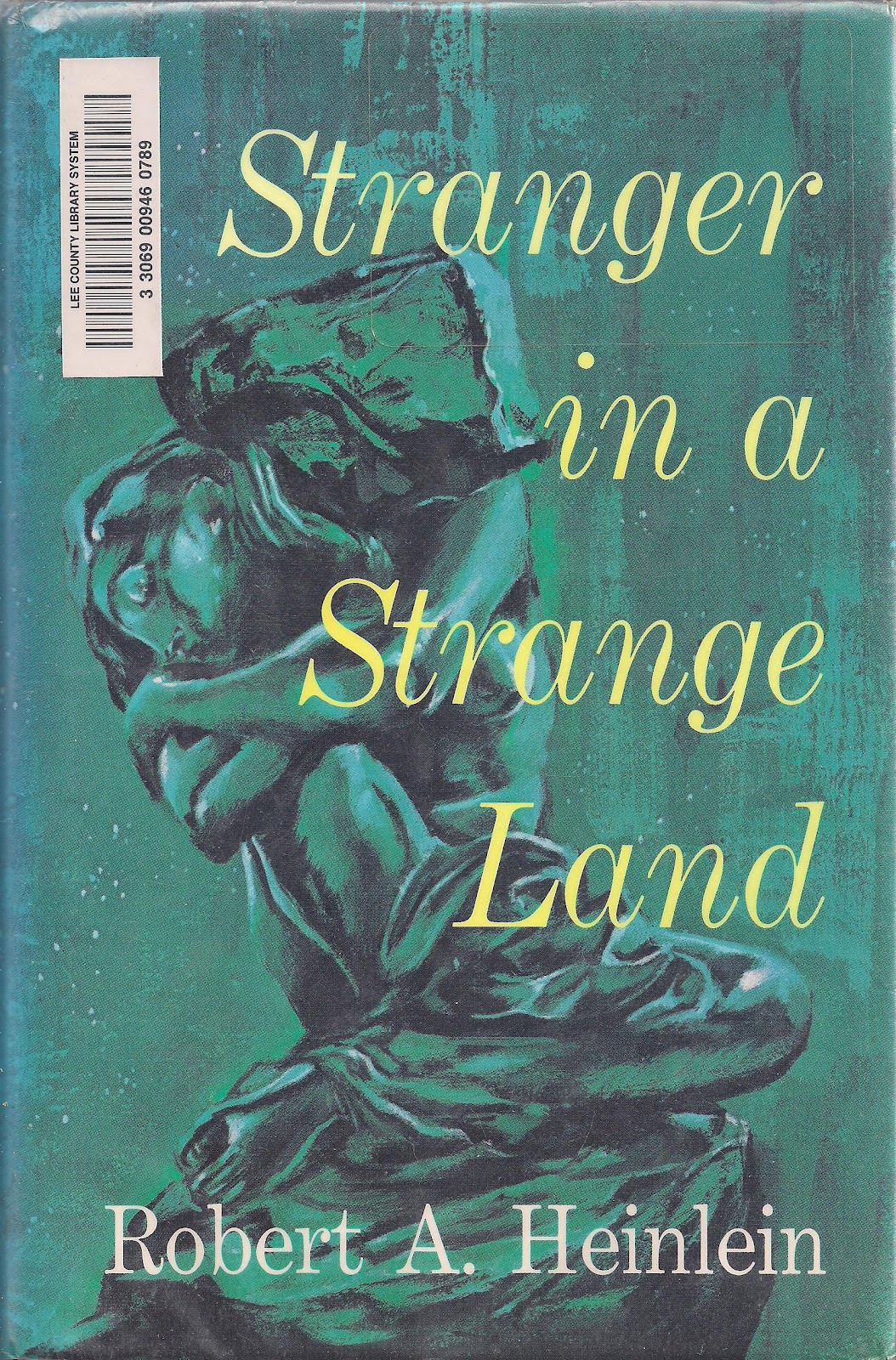
Stranger in a Strange Land

I think this is one of my favorite SiaSL covers

Stats
Stranger in a Strange Land by Robert A. Heinlein
1962 Hugo Award Winner
408 Pages

Earth’s first expedition to Mars was thought to have resulted in every crew member dying.  Earth’s second expedition to Mars, some years later, revealed that not only was Mars inhabited, but there was even a survivor from the first crew…and he’s coming home.

As it turns out that survivor is Valentine Michael Smith, actual the son of two of the crew members, born in space and raised by Martians.  When he finally arrives it becomes clear that he is more alien than human and the rest of SiaSL is spent with Mike, the Man from Mars, trying to figure us out, to grok us.  What he finds is funny and sad and horrific and finally, he learns, hilarious.


Coming to Earth
I’ve read this book a few times and Mike’s arrival on Earth was still funny.  I still laughed out loud at his failure to understand and everyone’s frustration with his innocence.  For whatever reason, I’m really attracted to the idea that extraterrestrial life would be so different from our own that even if we were able to make contact, we would utterly fail to interact.  The beginning half of SiaSL appealed to me for exactly that reason.  Martians exist, but the only Martian we could ever hope to talk to, and still struggle mightily with, is the one who is half-human (bodily he’s 100% human, but culturally Martian).  It’s funny and a little sad and I like it.

“The Heinlein Voice”
Bulky paragraphs of text which read like an undergrad philosophy paper do not constitute Hugo-Award-winning dialogue.  Unless of course you are Robert Heinlein.  There were actually 2 or 3 instances when the characters acknowledge that they are preaching, long-winded or just ranting and so it seemed to me that maybe by 1961, Heinlein was aware of his criticism and was basically telling people, I know and I don’t care and I can lecture all I want and you’ll still love it.  Which people did.

When I have read this book in the past (the last time being a number of years ago), I missed or overlooked or whatever, all of this.  I guess I only heard what I wanted to at the time.  I think I read this for the first time in college, so maybe the lectures seemed normal to me at the time.  I’m not sure how I missed the homophobic and misogynist attitudes by a group of people claiming to eschew prejudice and promote free love for all, but it bothered me quite a lot this week.

These things were so barefaced that Jill, Mike’s water brother who almost never speaks wrongly, tells him “Nine times out of ten, if a girl gets raped, it’s partly her fault.”  In some of his other books, I’ve thought maybe the way he treated women was kind of tongue-in-cheek, but once you start considering the role and treatment of women throughout his work, it starts to look like a history of violence toward women.  SiaSL must be one of the most blatant examples, and the most troubling to me.  A man comes from Mars and starts a cultural revolution full of stereotypical gender roles claiming it’s something new and different when really it’s just reheated leftovers.

If it is the most blatant, it is also the most offensive.  The above quote speaks for itself, but there is also a decidedly anti-intellectual tone which was a little off-putting.  Sure I think universities have tended to become more like fast-food restaurants than I’m comfortable with, but Heinlein dismisses the value of intellectual and scientific discourse offhandedly while at the same time resting the crux of Mike’s beliefs and Martian culture on philosophy’s that he would excoriate elsewhere.  It’s disingenuous and deceitful in my opinion.

It seems to me that the peripatetic style of Jubal and Jill and Mike would appeal to those who are interested in philosophical topics but haven’t much experience with them (maybe this applied to me), but Jubal and Mike are so muddleheaded sometimes that I can’t believe I ever fell for it.  This is one of those instances in which a thing looks like a duck and quacks like a duck but is decidedly NOT a duck.

I was warned that Heinlein’s tendency to lecture hit a high point here and I doubted it and I was wrong.

Recommendation
Although SiaSL was fairly popular at the time of its release, it is probably best described as a cult classic now.  I’m aware it influenced a generation, but to read it now is at times, more than a little difficult.  When Mike first comes to Earth and during his time spent in “the place”, Jubal’s own Fortress of Solitude, some of the dialogue is funny and Mike’s inability to grok is even funnier, but that’s about it.  I can’t say whether that will be enough to propel you through the rest of the book but I will tell you that the last 100 or so pages were excruciating.  While the beginning was great, I hated the end of this book so much that I’m embarrassed that I have ever liked it and recommended it to other people.  Erg…

HEP SCORE

Universe 3/5
Social/Political Climate 5/5
Dialogue 1/5
Scientific Wonders 5/5 (Here, I’m counting Mike’s Martian abilities)
Characters 4/5 (After everything I’ve said I still liked the people, especially Jubal if he would just SHUT UP!)

Overall 18/25

The roll of the die
This week’s book is The Wanderer by Fritz Leiber.  I had to enlist the help of my favorite librarian (my mom) to get ahold of this one, so it better be worth it.  My copy is one of those university copies with tiny print and zillion words on each page.

Next week’s book is The Man in the High Castle by Phillip K. Dick.  I’ve read one other PKD novel, Androids, and it was amazing, so I have high hopes for this one.

26 February 2012

Fahrenheit 451


Stats
Fahrenheit 451 by Ray Bradbury
Published in 1953
First published in Galaxy Science Fiction
RETRO Hugo Awarded in 2004
175 pages
My first re-read!


Rule 1.  Answer the alarm swiftly.
         2. Start the fire swiftly.
         3. Burn everything.
         4. Stand alert for other alarms.
Page 35


Does everyone know the plot of Fahrenheit 451?  I think so.  Firefighters no longer put fires out, but start them.  Books have been outlawed so they burn books, and the houses they’re in.  One firefighter, Guy Montag, begins to question his role in society after meeting a strange girl who is convinced there is more to life than driving fast and watching television.

Memory
I’m not sure but I think I must have been in high school when I read this book for the first time and I remember generally enjoying it, but I don’t remember what about it I liked.  This time around, I felt so inured to the censorship theme that I was uninterested in reading it.  Of course, by the die’s decree I have no choice but to read it, so I forced myself. 

I first read it long enough ago that I only remembered most of the major events about the book and none of the details.  I had the strangest experience though when, near the end of the book, Montag imbibes an elixir which is meant to disguise his scent and he’s told, “You’ll stink like a bobcat, but that’s alright.”  I didn’t find it all that funny this time around, but reading this specific phrase recalled a memory of sitting somewhere, in class, or in my room when I read that for the first time and thinking it was the most hilarious thing I’d ever read.  The recall was so detailed and it ran through my head so vividly that it almost made the phrase funny again.  It was a really strange and really cool feeling.

It was so unexpected, I hadn’t even remembered that line.  I really enjoyed trying to hold onto that fleeting, but strong, mental connection.  Weird, the things we hold onto.  It is somewhat fitting though, as Montag struggles with his memory of what life was like before, and occasionally gets flashes of distant memories of his past.

How (not) to read this book
This book is ostensibly a story about the perils of censorship and the book cover (the picture this week is not my copy) really tries hard to prime your understanding of the book in this way (maybe it’s the publisher’s idea of satire).  But based on Bradbury’s own note at the end (my printing included an Afterward and Coda!  Really?), that seems to be the theme that he was most concerned with when writing it.  People, I’m here to tell you, you don’t have to read it this way!  That’s right, I’m the F451 gadfly.

For obvious reasons, this cover spoke
to me more than my copy.
Return to rule 3 of the Firefighters Code.  Burn everything.  The Code struck me as a very powerful image in my second read and I think this is one of the first hints into what is going on below the surface of Bradbury’s horrible method of telling, not showing (one of the most severe crimes a writer can commit).  We begin to find that it isn’t just part of the Firefighter’s Code, but that all of society is on a path toward complete destruction.  Of books, of friends, of families, all of society is in rapid decline.  All-out war threatened to destroy everything and everyone.  Husbands and wives spend their lives together and don’t know a single thing about each other.  Montag can’t even remember how he met his wife.

These are the phenomena that really upset Montag.  He had everything in the world to make him happy and he was still miserable and what’s worse, he had no idea why or what to do about it.  It is only when he comes to believe that books are the only tool remaining that might possibly set humanity right again that he obsesses with saving books and bringing down the firefighters.  Montag wasn’t on a crusade to see to the survival of books; he was on a crusade to save his species!

I think what has made people so hooked on the censorship issue is only that Bradbury hammers his readers over the head with lectures far worse than Heinlein ever did.  And even though the book also warns against allowing others to tell us what to believe, we still listen, rapt, to Bradbury’s, skin-deep interpretation (Bradbury loved starting sentences with conjunctions too).  Just because you create a work of art, doesn’t mean you have the final say regarding what is important and why.  That is my job ;)

Considering recent world events, the idea of such strict censorship and governments limiting communication are still very poignant and just as scary as in 1953.  But as I said, I’ve become so de-sensitized to the story over the years that this wasn’t the most interesting aspect to me.  You’ll get out of it whatever you want, but know there are other things going on below the surface if you care to look.

Recommendation
I have the rest of the nominees from this year lined up in my audiobook queue.  I have a strong suspicion that this book could only be chosen in hindsight, because so many people are nostalgic about it, not that it was the “best.”  I didn’t love the book, but I also didn’t hate it.  It was just kind of…meh…  There were still a number of elements that make the book historically significant and worth reading if you’ve never gotten around to it.  Bradbury has a way with words that even if he force feeds readers, he can create moods (see this week’s Epic Quote) and set up a scene in a way that is just amazing.

HEP SCORE

Universe 1/5 (Boring)
Social/Political Climate 5/5
Dialogue 4/5
Scientific Wonders 1/5 (Everything but the hound is also...boring)
Characters 3/5

Overall 14/25

This week’s book is Farmer in the Sky by Robert Heinlein.  This is the second book of the decade by Heinlein and the final RETRO Hugo.  As I said last week, this is a pretty important book since the two Heinlein books from the 50’s will be battling it out for the unofficial master of the precious award. 

Next week’s book is A Case of Conscience by James Blish.  I know very, very little about this one, and I’ve never read anything by Blish so this will be my 4th new author since beginning this project.  Of course that means that there is only one book left so I won’t need to role the die next week which makes me very, very sad.  I need a support group.
Related Posts Plugin for WordPress, Blogger...